
Introduction
Want to learn the fundamentals of Trademark Law? Read our complete Trademark Law Guide.
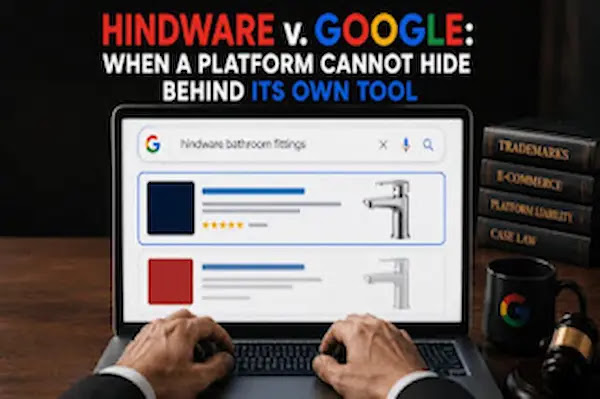
You type “Hindware” into Google Search. You already know the brand, and you are looking for one specific company. What Google showed you, at the top of the results page, was an advertisement for competitors, Grohe Or Cera. Not Hindware.
How? Because Grohe and Cera had paid Google to intercept that exact search. Through Google’s AdWords programme, they bid on the keyword “HINDWARE” and won placement in the sponsored results whenever anyone searched for it. Google ran the auction, collected the money, and delivered their advertisement to your screen. Hindware got nothing from the arrangement. Hindware did not consent to it.
This went on for years. Hindware filed suit in 2017. The case wound through the Delhi High Court for nine years before it was decided on May 22, 2026. The judgment runs 163 pages and the core holding fits in one sentence: Google is not a neutral intermediary when it auctions a trademark to that trademark’s competitors. It is a participant in the infringement, and it is liable.
How the Technology Works
Google Ads works through a real-time auction. An advertiser tells Google: show my advertisement whenever someone searches for this keyword. The advertiser bids a price per click. Google runs the auction in the fraction of a second between a user submitting a query and the results page loading.
The keyword itself never appears in the advertisement. If Grohe bids on “HINDWARE”, Grohe’s advertisement does not say “HINDWARE” anywhere. The consumer sees Grohe’s branding, Grohe’s products, Grohe’s link. The word HINDWARE is a backend trigger only.
This invisibility was Google’s entire legal argument. The trademark does not appear in the advertisement. The consumer cannot be deceived by text they never read. Google just provides the infrastructure. Anyone can use it. Google is a neutral conduit.
This argument had worked before. In MakeMyTrip India Pvt. Ltd. v. Google LLC (2022) the Delhi High Court accepted a version of it, holding that invisible keyword bidding would not amount to actionable trademark use. Kent RO Systems v. Amit Kotak (2017) took the same restrained position. For nearly a decade, the invisibility of the backend trigger was Google’s shield.
Hon’ble Justice Pushkarna put that shield down.
What the Court held
Section 29(6)(d) is the provision that decides this case. It says a registered trademark is infringed when someone uses it in advertising without the proprietor’s consent. The Act does not say the trademark must be visible to the consumer. It says it must be used in advertising.
The Court held that keyword advertising is use in advertising. When Google sells the keyword “HINDWARE” to Grohe, the mechanism that delivers Grohe’s advertisement to consumers searching for Hindware is the trademark itself. The trademark is doing the work. It is directing traffic. The fact that the consumer never reads the word in the advertisement does not change what the trademark is doing commercially.
Section 29(8) gave the Court a second, independent ground. This provision does not require proof of confusion. It captures use that takes unfair advantage of a mark’s reputation or that acts contrary to honest practices in industrial and commercial matters. HINDWARE is a coined term. It has no dictionary meaning. No consumer searches for it to find bathroom fittings generically. They search for it to find Hindware specifically.
Google knew this. Google’s own auction system relies on consumers having built-up brand preference for specific marks. The more valuable the brand, the more competitors will pay to intercept its searches. That value belongs to Hindware. Google monetised it without permission.
The Court’s own words on this: “Google cannot be permitted to shrug off responsibility by making available a tool that leads to infringement, and then turning around to claim that the said tool was not mandatory.”
The Older Cases and Why the Court Moved Away From Them
Before Hindware, Indian courts treated visibility as the threshold question. If the consumer cannot read the trademark in the advertisement, there is no deception, therefore no infringement. This is a coherent position. It is also, after Hindware, no longer the law.
The Hindware Court’s departure from MakeMyTrip case and Kent RO case is deliberate and reasoned. The Court does not say those cases were wrong on their facts. It says the analysis needs to change when applied to a coined, well-known mark being auctioned to direct competitors. The question is not whether the consumer reads the trademark. The question is what commercial function the trademark is performing in the transaction.
Here, the answer is clear. HINDWARE performs the function of attracting consumers who already want Hindware’s products. That function is being exploited by Grohe and Cera through Google’s auction. The trademark is working exactly as a trademark should work, except the beneficiary of that work is not the trademark owner.
The European Court of Justice reached a functionally similar conclusion in Google France v.Louis Vuitton (2010). The ECJ held that keyword advertising can affect a mark’s origin function even when the mark does not appear in the advertisement. The Delhi Court’s reasoning runs along the same track without importing the EU framework directly. The domestic provisions, read purposively, get to the same place.
Section 79 of the IT Act and why Google Lost the Safe Harbour Argument
Google’s second line of defence was Section 79 of the Information Technology Act, 2000. This provision protects intermediaries from liability for third-party content they host or transmit, provided they follow due diligence requirements under the Intermediary Guidelines and do not initiate or select the transmission themselves.
The Court refused safe harbour on three grounds, each independent of the others.
- Google selects the receiver of the transmission. The auction algorithm decides which advertisement appears for which search query. That is a selection. Section 79 protection requires the intermediary to not initiate or select transmissions. Google does both.
- Google fails the due diligence requirement. The Intermediary Guidelines require platforms to take action on actual knowledge of infringement. Google knows that registered trademarks are being auctioned to competitors of those trademark owners. It takes no steps to prevent this. A platform that knows and does nothing cannot claim the protection designed for platforms that genuinely did not know.
- Google actively aids the infringing use. The Court drew on Christian Louboutin SAS v. Nakul Bajaj (2018), where the Delhi High Court stripped safe harbour from an e-commerce platform that actively promoted and facilitated the sale of infringing goods. The principle is that active participation in the infringing transaction disqualifies the intermediary claim. Google’s keyword suggestion tools, its auction infrastructure, its monetisation model, and its ad ranking system together make it an active participant, not a passive conduit.
The Timeline:
Shreya Singhal v. Union of India (2015) established broad safe harbour for neutral conduits. Christian Louboutin (2018) removed it from active e-commerce facilitators. Hindware (2026) removes it from active advertising platforms. Each step narrows the category of platform that can claim neutrality.
Both Google Entities Are Liable, Jointly and Severally
One practical question in cases involving multinational platforms is which entity to sue. Google LLC is a US company. Google India Pvt. Ltd. is the Indian subsidiary that entered into AdWords agreements with Indian advertisers like Grohe India.
The Court held both entities jointly and severally liable. Google India cannot shelter behind the argument that it is a separate legal entity from Google LLC with no operational control over the AdWords programme. Its role in the contractual relationship with Indian advertisers is sufficient to fix liability. The Rs. 30 lakh in nominal damages is payable jointly and severally by both entities within eight weeks, along with actual litigation costs.
Here is a prime takeaway for IP law practitioners from this case. You do not need to sue only the US parent alone. The Indian subsidiary is a proper defendant with full joint liability.
The Advertiser Defendants Settled. Why Did the Case Continue Against Google?
By the time Hon’ble Justice Pushkarna delivered the judgment, Hindware had settled with Grohe India and Cera. The advertisers were out. Google argued that with the direct infringers gone, there was no surviving cause of action against it. The Court rejected this without hesitation.
Google’s liability is independent. It does not derive from the advertisers’ liability. Google’s own act of auctioning a registered trademark to competitors, without the owner’s consent, and collecting revenue from each click that resulted, is itself an actionable wrong. Settling with the people who placed the bids does not extinguish the claim against the platform that ran the auction. Rights holders can target the platform directly, even after settling with or obtaining injunctions against individual advertisers.
The Damages Question: Why Rs. 30 Lakh Is Not the Whole Story
The Court awarded nominal damages of Rs. 15 lakh in each suit, Rs. 30 lakh total. The word nominal is doing significant work here. The Court did not attempt to quantify what nine years of keyword diversion cost Hindware in lost revenue, diverted customers, or eroded market share. The Rs. 30 lakh is an acknowledgment of the infringement and a deterrence measure. It is not a compensatory valuation.
If you are advising a client who wants to bring a similar claim, this is the part to focus on. The judgment establishes liability clearly. The damages framework does not. Any future plaintiff who wants damages that reflect actual commercial harm needs to build that case with evidence: consumer surveys, conversion data, revenue impact analysis, the kind of forensic economic evidence that Hindware, nine years into litigation, apparently did not put before the Court in quantified form.
Whether this damages figure will encourage or discourage future claims is genuinely unclear. Rs. 30 lakh against Google is, commercially, almost nothing. Whether courts in future cases will award more when presented with better evidence is a question this judgment does not answer.
What India Does That the US Does Not
The US position under the Lanham Act has been substantially more permissive on keyword advertising. American courts generally permit it on the reasoning that no confusion arises when the sponsored advertisement clearly identifies the advertiser’s own brand. The consumer who sees a Grohe advertisement labelled as Grohe, after searching for Hindware, is not confused. They know they are looking at Grohe.
This is not an unreasonable position. There is a real argument that sophisticated consumers understand sponsored results. There is also a real counter-argument that the consumer who searched for Hindware did not want to be shown Grohe at all, regardless of how clearly Grohe is labelled.
The EU sits between the two. The ECJ in Google France (2010) held that keyword advertising can infringe where it adversely affects the origin function of the mark, but left substantial room for platform immunity where the role was passive. The Delhi Court in Hindware has gone further than both: it imposes direct platform liability, not just advertiser liability, and it applies a commercial function test rather than a consumer confusion test.
Whether that position survives appellate scrutiny is a legitimate question. The US approach has decades of jurisprudence behind it. The EU approach has an entire regulatory apparatus around it.
Also read: Moti Mahal Trademark Dispute
What This Judgment Does Not Cover
Three questions that practitioners will face immediately, none of which Hindware resolves.
- Descriptive and generic marks. The Court’s entire analysis rests on HINDWARE being a coined term with no independent meaning. A generic or descriptive mark presents a harder case. If a competitor bids on “sanitaryware” or “bathroom fittings”, those words describe a product category and any manufacturer has a legitimate commercial reason to appear in searches for them. The commercial function analysis in Hindware does not translate directly. Courts will need to work this out case by case.
- Comparative advertising. The judgment does not address situations where a competitor explicitly names a rival’s brand in the advertisement itself, to draw a comparison or claim superiority. That has its own doctrinal treatment and the Hindware analysis does not govern it.
- Reverse bidding. What if a trademark owner bids on a competitor’s mark? The logic of Hindware looks symmetrical, but the Court was not asked and did not answer. This remains open.
Also Read: Calcutta HC Returns ITC Plaint for Skipping Section 12A Mediation
Conclusion
Nine years is a long time to wait for a clear answer. The answer, when it came, was unambiguous: Google participates in trademark infringement when it auctions a coined, registered trademark to that trademark’s competitors. The invisibility of the backend process is not a defence. Section 79 protection is unavailable to a platform that selects, facilitates, and profits from the infringing transaction.
What I find genuinely interesting about this judgment is where it leaves the broader question of platform liability. The Court’s logic is principled: active commercial participation in an infringing transaction disqualifies a platform from claiming neutrality. That principle extends well beyond keyword advertising. Applied consistently, it reaches any platform that algorithmically selects and monetises content in ways that benefit from a third party’s intellectual property.
Whether that is where Indian IP law should go is a different conversation. There are legitimate interests on Google’s side too. The keyword advertising model, for all its problems for trademark owners, also creates real consumer value. A consumer who searches for Hindware and sees Grohe at the top might genuinely prefer Grohe at a lower price point. Blocking that comparison entirely is not costless. The Court did not engage seriously with this counter argument.
Case: Hindware Ltd. v. Grohe India Pvt Ltd and Ors. CS(COMM) 591/2017, 22 May 2026.